Hey there! I’m a supplier of Digital Sand Tables, and today I wanna chat about a super interesting topic: What is the maximum elevation that a Digital Sand Table can represent? Digital Sand Table

First off, let’s understand what a Digital Sand Table is. It’s a high – tech tool that combines digital technology with a physical model. It can display various geographical information, like terrain, elevation, and even simulate different scenarios. It’s used in a bunch of fields, from urban planning and military strategy to environmental research.
So, what’s the deal with the maximum elevation it can represent? Well, it depends on a few key factors.
Hardware Limitations
The hardware of a Digital Sand Table plays a huge role. The sensors and actuators that control the elevation of the physical model have their own limitations. For example, the motors that move the surface of the sand table to represent different elevations have a maximum range of motion. If the motor can only move up and down by a certain distance, then that sets a limit on the elevation it can show.
Let’s say we have a basic Digital Sand Table with a relatively simple motor system. The motor might only be able to move the surface up by 10 centimeters. If we’re using a scale of 1:1000, that means in the real – world, it can represent an elevation difference of 100 meters. But if we upgrade to a more advanced motor system with a greater range of motion, say it can move up by 20 centimeters, then at the same 1:1000 scale, it can represent an elevation difference of 200 meters.
Another hardware aspect is the resolution of the sensors. High – resolution sensors can detect smaller changes in elevation, allowing for a more detailed representation. But if the sensors are low – resolution, they might not be able to accurately represent very small elevation differences, which can also limit the overall elevation range that can be effectively shown.
Software Constraints
The software that runs the Digital Sand Table is also crucial. The algorithms used to convert digital data into physical elevation changes have their limitations. Some software might have difficulty handling extremely large elevation differences. For instance, if the software is designed to handle elevation data within a certain range, say from 0 to 500 meters, and you try to input data for an elevation of 1000 meters, it might not be able to process it correctly.
Moreover, the software needs to manage the relationship between the digital model and the physical representation. If the software can’t accurately translate the digital elevation data to the physical movement of the sand table, then the maximum elevation that can be represented will be affected.
Scale Considerations
The scale of the Digital Sand Table is a major factor. A larger scale means that a smaller physical distance on the sand table represents a larger real – world distance. For example, a scale of 1:1000 is different from a scale of 1:10000. If we have a Digital Sand Table with a maximum physical elevation change of 20 centimeters, at a 1:1000 scale, it can represent a real – world elevation of 200 meters. But at a 1:10000 scale, the same 20 – centimeter physical change represents a real – world elevation of 2000 meters.
However, using a very large scale also has its drawbacks. At a large scale, the physical details on the sand table might be less clear. For example, small hills or valleys that are important in a real – world scenario might not be accurately represented because the scale is too large.
Real – World Applications
In different applications, the required maximum elevation varies. In urban planning, we usually deal with relatively low – elevation differences, maybe up to a few hundred meters. For example, when planning a city with some small hills or slopes, an elevation range of 100 – 300 meters might be sufficient.
On the other hand, in military applications, especially for mountainous regions, a much larger elevation range might be needed. Some mountain ranges can have elevations of several thousand meters. So, a Digital Sand Table used in military strategy might need to represent elevations up to 3000 – 5000 meters or even more.
In environmental research, if we’re studying a large – scale ecosystem that includes high mountains and deep valleys, a wide elevation range is also necessary. For example, in a study of a mountainous rainforest, we might need to represent elevations from sea – level to several thousand meters to understand the different ecological zones.
Pushing the Limits
As a Digital Sand Table supplier, we’re constantly working on pushing the limits of what our products can do. We’re investing in research and development to improve the hardware and software. For the hardware, we’re looking into more advanced motors and sensors that can handle larger elevation changes and provide higher resolution.
In terms of software, we’re developing more sophisticated algorithms that can handle a wider range of elevation data and ensure accurate translation from digital to physical representation. We’re also working on improving the scalability of our products, so that they can be adjusted to different scales depending on the specific needs of our customers.
Conclusion
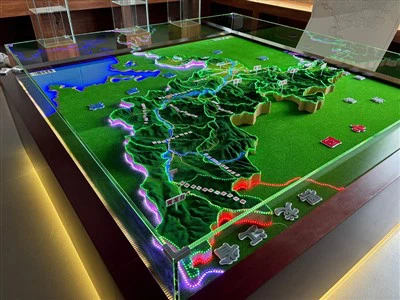
So, to answer the question of what the maximum elevation a Digital Sand Table can represent, there’s no one – size – fits – all answer. It depends on the hardware, software, scale, and the specific application. But with continuous innovation and improvement, we’re getting closer to representing larger and more accurate elevation ranges.
Terrain Model If you’re in the market for a Digital Sand Table and have specific elevation requirements, whether it’s for urban planning, military use, or environmental research, I’d love to have a chat with you. We can discuss your needs and see how our products can meet them. Don’t hesitate to reach out and start a conversation about your Digital Sand Table project.
References
- "Principles of Geographical Information Systems" by Paul A. Longley et al.
- "Military Geospatial Intelligence" by David E. Rhind
- "Urban Planning and Design" by Peter Hall
Guangzhou Zonco Culture and Media Co., Ltd.
Guangzhou Zonco Culture and Media Co., Ltd. is one of the most reliable digital sand table manufacturers and suppliers in China, also supports customized service with low price. We warmly welcome you to wholesale cheap digital sand table from our factory. For quotation, contact us now.
Address: Room C371, 402, Building 6, No. 3 Xintang Street, Tianhe District, Guangzhou
E-mail: 13123180052@163.com
WebSite: https://www.scalemodellab.com/
