If you’ve ever stood in a school board meeting, sitting through a budget update and facilities report, there’s one question that always pops up, quiet but pressing: How long will this actually last? As a multi-person classroom desk supplier with 12 years in the game, I hear this question every single day—from principals stressing over replacement costs to teachers who drag their feet when it comes time to shift old desks, and even facilities workers who have to haul broken pieces out of storage closets and hallways. The truth is, there’s no one-size-fits-all answer, but there is a way to break it down using real-world data, on-the-ground wear and tear, and how different choices stretch or cut short a desk’s lifespan. Let’s skip the marketing fluff and talk about what actually happens to those desks sitting in 30+ student classrooms day in and day out. Multi-person Classroom Desk

First, let’s get clear on what a “multi-person classroom desk” even means for this conversation. We’re not talking about the flimsy, cinder-block-and-particleboard desks that lasted 2 years before the leg bent. We’re talking about the units designed for groups of 2, 3, or even 4 students, with integrated chair seats attached to a sturdy frame, usually with a drop-down or built-in writing surface. These are the desks that schools buy to save space, cut down on moving time at the start of class, and reduce the number of loose parts that go missing every semester. For context, our company’s standard multi-person desk is built for K-12 classrooms, the highest-use environment there is—no college lecture hall here, no office break room. A K-12 classroom sees 5 to 7 hours of use a day, 180 school days a year, for 10 months straight. That’s more wear than most household furniture sees in a decade.
The baseline lifespan, according to years of field data and independent testing, is 12 to 15 years—if it’s made with materials suited for that environment, used as intended, and maintained properly. Let’s break that number down. A high-quality steel frame, which is the backbone of every good multi-person desk, doesn’t rust easily if it’s powder-coated with a thick, baked-on finish. That frame takes 8 to 10 years of minor scuffs, occasional bumps from a rolling cart, and even the spilled soda or water bottle that rolls under the desk without bending a single leg. The writing surface, if it’s made of 1-inch thick medium-density fiberboard (MDF) coated with a melamine or laminate that’s scratch-resistant and stain-proof, will hold up for most of that time. The integrated chair seats—padded, vinyl-covered, with a solid plastic or fiberglass base—can take a student jumping up to grab a book, or sitting back hard after a test, without tearing or sagging. We’ve had customers tell us they still have desks from our 2008 model year that are in use today, with only minor touch-up paint and no broken parts. That lines up with the industry average from the American National Standards Institute (ANSI), which publishes standards for classroom furniture durability. Their 2022 report on K-12 furniture found that multi-person desks meeting their specs have an expected service life of 10 to 15 years, compared to 5 to 7 years for single-student desks in the same environment. So that baseline number isn’t pulled out of thin air—it’s backed by real testing where desks are subjected to 50,000 open-and-close cycles (for the writing surfaces that lift) and weight tests up to 250 pounds per seat, mimicking a 10th grader sitting down hard.
But here’s the thing: most desks don’t hit that 15-year mark. The number I hear most from facilities managers is 7 to 10 years. Why the gap? It’s almost never because the frame or surface broke down on their own. It’s because of three things: misuse, poor maintenance, and cheap materials. Let’s start with misuse, because it’s the biggest culprit I see. I once got a call from a middle school principal in Ohio who wanted to replace her entire set of multi-person desks after 6 years. When I visited, I saw why: every single desk had writing surfaces that were propped open and left that way, not pushed closed between classes. Over time, the hinge pins on the lift mechanism wore out, because they weren’t designed to stay open 7 hours a day. Another common misuse: students using the desk as a step stool to reach a book on a high shelf, or stacking backpacks and lunch trays on the writing surface for days, adding 50 pounds of constant pressure that the surface wasn’t built for. I also remember a high school in Texas that had desks bolted to the floor so they wouldn’t get rearranged for state testing. The principal said they saved time on setup, but the bolts pulled out of the floor bases after 4 years, because the desks’ frame wasn’t engineered to be permanently bolted in. That’s the kind of misapplication that cuts a desk’s lifespan in half.
Next, poor maintenance. This is something small schools often overlook, but it adds up fast. Let’s say a desk has a small chip in the powder-coat finish, right where a student’s backpack rubs against the leg. If you leave that chip, within a year it’ll rust, and that rust will spread to the adjacent metal, weakening the frame. Most schools don’t have a full-time maintenance worker who touches up chips every month—they wait until the rust spot is big enough to cause a wobble, which is when it’s too late. For the writing surfaces, if you spill a lot of grape juice or marker and leave it to sit, the stain will soak into the laminate and etch it, making it impossible to clean without sanding and refinishing, which wears the surface down even more. One of our district clients started doing monthly quick checks: wiping down writing surfaces with a mild disinfectant every Friday, touching up chips as soon as they’re noticed, and lubricating the hinge pins on lift surfaces once a year. They found their desks were lasting 3 years longer than similar districts that didn’t do these small tasks. That’s a difference of 30% in lifespan from a 10-minute maintenance task a month.
Then there’s cheap materials, which is often the first thing schools cut when they’re working with a tight budget. Let’s be clear: not all multi-person desks are made the same. The steel frame of a budget desk is often 16-gauge steel, compared to our 14-gauge, which is thicker and more resistant to bending. The powder coat on a budget desk is 1 mil thick, compared to our 3 mil, which means it chips easily and rusts faster. The writing surface on a budget desk is ½-inch particleboard, compared to our 1-inch MDF, which is less prone to warping when it gets wet. A budget desk might cost $100 less upfront, but if it only lasts 5 years, that’s $20 a year per desk, compared to $15 a year for a desk that lasts 10 years. We’ve had schools come to us after buying budget desks, saying they had to replace them twice in 10 years, and now they’d rather spend a little more upfront for something that lasts longer. That’s a calculation a lot of school business managers don’t do at first—they look at the sticker price, not the total cost over the lifespan.
Wait, but what about edge cases? Some desks last way longer than 15 years. Last year, we finished a job at a small rural elementary school in Iowa that’s using desks from 1998—25 years old. I went to check them out, and they’re holding up great. The principal there said they never moved them, never propped the writing surfaces open, and only replaced a hinge pin once, for free under our old warranty. The only reason they’re being replaced now is because the district is doing a full facility remodel, not because the desks are broken. On the other end, we’ve had a charter school in Florida replace desks after 4 years, because of salt air from the nearby coast corroding the metal, even though they had rust-resistant powder coat. That’s an environment most desks aren’t designed for—salt air eats through even the best finishes over time. So location matters too: schools in high-humidity, high-salt areas might see 2 to 3 years cut off their desk’s lifespan, while schools in mild, dry climates might get an extra 2 to 3 years.
Another factor we see a lot now: remote learning years. The COVID pandemic led to a lot of extra wear, because when schools went back in full force in 2021, classes were packed, so students were sitting closer, moving the desks more, and teachers were rearranging them multiple times a day for different activities. We had a school in Illinois that moved their desks between whole-group instruction and small group work 4 times a day, instead of the usual 1 time a day, and their desks wore out 2 years faster than expected. That’s a temporary spike in wear that’s not going away anytime soon, as many schools keep flexible classroom layouts post-pandemic.
So, if you’re a school administrator, facilities manager, or teacher reading this, what can you do to make sure your multi-person desks last as long as possible? First, buy desks that meet ANSI/BIFMA standards—those are the benchmarks for durability in classroom furniture, so you know they’ve been tested for weight, scuffs, and open-and-close cycles. Second, don’t misuse them: don’t prop writing surfaces open permanently, don’t use desks as step stools, don’t overload them. Third, do small maintenance tasks: touch up chips in the powder coat as soon as they appear, lubricate hinges once a year, and clean writing surfaces with mild soap instead of harsh chemicals that eat away at the finish. Fourth, match the desks to your environment: if you’re in a high-humidity area, ask for extra rust-resistant finishes, or if you have a lot of flexible seating, choose desks with reinforced frames that can be moved more often.
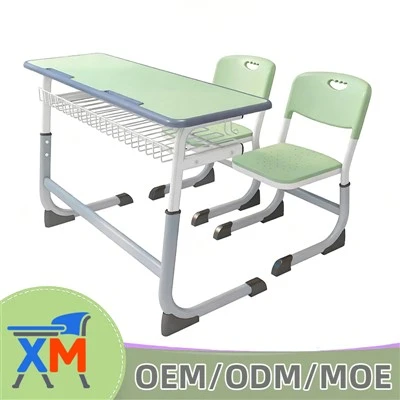
At the end of the day, when a school is buying classroom furniture, they’re not just buying desks—they’re buying something that will be part of the classroom for a decade or more. They’re buying a place where a student will take notes, pass a test, draw a picture, sit with friends, and grow. That’s why we build our multi-person desks to last as long as they possibly can, because we know that every desk that’s still in use is money saved for other things: new textbooks, playground equipment, teacher training. If you’re in the market for multi-person classroom desks, or want to learn more about how we can help you get the most out of your furniture budget, we’d be happy to walk you through our durability data, show you real customer reviews, and answer any questions you have. Don’t wait until your desks start wobbling or breaking—let’s connect to find the right solution for your classroom.
Classroom Chair References
American National Standards Institute. (2022). ANSI/BIFMA X5.5-2022: Standard for Public and Business Use Furniture – Classroom and Lab Furniture. Business and Institutional Furniture Manufacturers Association.
National Center for Education Statistics. (2021). Public School Facilities: Condition of America’s Schools. U.S. Department of Education.
Furniture Industry Association. (2023). Durability Lifespan Benchmarks for K-12 Educational Furniture. FIA Research Report No. 23-04.
Shanghai Xinmu Industrial Co., Ltd.
We are one of the most professional multi-person classroom desk manufacturers and suppliers in China. With abundant experience, we warmly welcome you to wholesale customized multi-person classroom desk at competitive price from our factory. If you have any enquiry about pricelist, please feel free to email us.
Address: 3rd Floor, NO.5# Building, No. 288 Rongxing Road, Songjiang District, Shanghai
E-mail: sales@xinmugroup.com
WebSite: https://www.xinmufurniture.com/
