If you’re deep in the world of industrial cooling systems, you’ve probably heard the term “closed circuit cooling tower” thrown around a lot. And if you work with these systems day in and day out, you already know they’re way more than just a big metal box that blows hot air outside. A lot of folks focus on the tower’s fans, frames, and how it keeps process equipment from overheating—but one part that gets overlooked more often than it should? The water treatment system that’s built right into it. As someone who’s been supplying closed circuit cooling towers for years, I’m here to break down why that water treatment setup isn’t just a “nice-to-have”—it’s the backbone of how the whole thing works, and how you keep it running for decades without a ton of headaches. Closed Circuit Cooling Tower
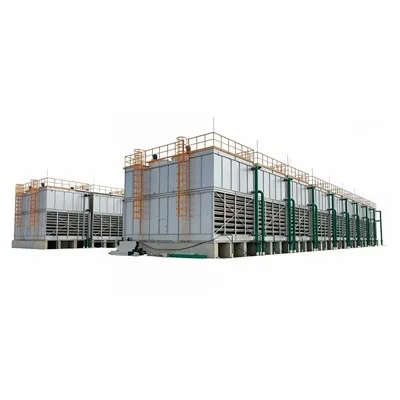
First off, let’s get super clear on what a closed circuit cooling tower actually does, because that context is everything. Unlike open cooling towers, where the process water mixes directly with the atmosphere and the make-up water you add, a closed circuit system has a secondary loop that’s totally sealed. The actual process water (the stuff that’s sucking heat out of your machines—think compressors, data center servers, manufacturing ovens, whatever) flows through a heat exchanger tube bundle inside the tower. Then, a separate, smaller loop of water (the tower’s own circulating water) flows around those tubes, pulling the heat off, and then that tower water gets cooled by the tower’s fans before looping back. Got it? Good. Now, the water treatment system is specifically for that separate tower loop—though it often works hand in hand with treatment for the process side too, depending on the setup.
A lot of people make the mistake of thinking, “Oh, it’s just water—what’s the big deal? I’ll just pour in some chlorine and call it a day.” Nope. That’s a one-way ticket to disaster, and I’ve seen way too many of my clients go that route. Let’s start with the number one enemy of any cooling system: scale. Scale is that hard, crusty buildup of minerals like calcium, magnesium, and silica that forms when water heats up and evaporates (even in a closed loop, there’s a tiny bit of evaporation to keep the tower working, right? Because that’s how it pulls heat). If scale builds up on the outside of those heat exchanger tubes that the process water is flowing through? That’s like wrapping your engine radiator in a thick blanket. The heat can’t transfer properly, so your system has to work way harder to keep things cool. That means higher energy bills, more wear and tear on your fans and pumps, and eventually, if it gets bad enough, you have to shut down operations to replace the tubes. The water treatment system prevents that by balancing the water’s chemistry—adjusting pH levels, adding scale inhibitors that stick to mineral particles so they don’t bind to metal, and regularly testing the water to make sure the mineral concentration doesn’t get too high.
Then there’s corrosion. Wait, corrosion? In a closed loop? Yeah, even sealed systems have tiny little gaps, air that gets trapped during startup, and oxygen that dissolves in the water over time. And if your water isn’t treated, that oxygen eats away at the metal parts of the tower—steel frames, copper heat exchangers, even the stainless steel pipes if they’re not high grade. Corrosion causes pitting, which is like tiny holes in the metal. Those pits weaken the structure over time, and if they get bad enough, you get leaks that let the tower water mix with the process water. Imagine that—if your process water is for food and beverage manufacturing, that’s a total contamination nightmare. If it’s for data centers, that’s a short circuit risk. The water treatment system stops that by adding corrosion inhibitors, things that create a thin, invisible protective layer on the metal surfaces so oxygen and water can’t get to them. It also keeps pH levels in the safe range—too acidic, and metal eats away faster; too alkaline, and you get that scale we talked about earlier. It’s a fine balance, and the treatment system is constantly monitoring to keep it there.
Next up, and this is a big one for a lot of industrial clients: biofouling. That’s the growth of bacteria, algae, fungi, and other microbes in the tower water. People think, “It’s sealed, how can anything grow?” Again, tiny leaks, make-up water added to replace the tiny amount that evaporates, even dust blowing in through the fan intakes can bring microbes. And once they grow, they form that slimy gunk called biofilm. Biofilm is way worse than it sounds. For one, it acts like insulation, so heat transfer gets even worse than scale. But even bigger, some of the bacteria that grow in cooling towers—you’ve probably heard of Legionella—are responsible for serious respiratory infections in humans. If your tower isn’t treating the water to kill these microbes, that’s a huge public health risk, especially if your facility is in a busy area, or if people work near the tower, or if the tower is part of a HVAC system for a large office or hospital. The water treatment system uses biocides—things like non-oxidizing biocides that target biofilm specifically, oxidizing agents like chlorine dioxide that keep bacteria in check, and even some eco-friendly options these days—to keep microbial growth in check. Regular testing for Legionella and other pathogens is built into the system too, so you never have to worry about a health inspection failing.
Wait, let’s not forget about water waste and efficiency. A big part of the closed circuit tower’s appeal is that it uses way less water than an open tower, right? Because the loop is mostly sealed, so you only have to add small amounts of make-up water instead of constantly dumping and refilling the whole system. But if your water treatment system is off, you end up having to drain and refill the tower way more often to get rid of excess minerals or microbes, which defeats the whole purpose of being water-efficient. Good treatment systems monitor things like conductivity or total dissolved solids (TDS) in real time, so you only drain a tiny bit of water when you need to, and only add make-up water as required. That cuts down on water costs, which is a huge deal for facilities in areas with water restrictions or high utility rates.
Also, let’s talk about equipment lifespan. I mentioned earlier that scale and corrosion damage parts, but a properly treated water system keeps all the tower components running smoothly. I’ve had clients tell me that they skipped a water treatment system upgrade once, and their tower’s heat exchanger tubes had to be replaced after just 5 years—costing them tens of thousands of dollars, plus downtime. Another client, a data center, had a biofouling issue that caused their server temperatures to spike, forcing them to shut down a rack to avoid equipment damage. That kind of downtime isn’t just expensive—for manufacturing or data centers, it can cost thousands of dollars per minute. The water treatment system eliminates that risk, so your closed circuit cooling tower doesn’t just cool your equipment, it protects your entire operation.
Now, I know what some of you are thinking: “Can’t I just buy a tower that comes with basic treatment, or do I need a separate system?” As a supplier, I’ll be straight with you: basic treatment is fine for small, light-duty applications, but for most industrial use—like large data centers, automotive manufacturing, food and beverage plants, or chemical processing—you need a tailored water treatment system that works specifically with your closed circuit tower. Off-the-shelf treatment rarely accounts for the exact water chemistry in your area, the temperature your tower operates at, or the specific equipment you’re cooling. For example, a tower cooling plastic molding machinery needs different treatment than one cooling a 100,000-square-foot office building’s HVAC system. A good water treatment system is customized to your needs, not one-size-fits-all.
And these days, it’s not just about the chemistry, either. A lot of modern water treatment systems are automated, with sensors that monitor pH, TDS, biocide levels, and corrosion rates 24/7. They can send alerts to your phone if something’s off, so you don’t have to send a technician out to test the water every week. Some even integrate with building management systems, so you can track cooling efficiency, energy use, and treatment performance all in one place. That saves time, cuts down on labor costs, and means you catch issues before they turn into big problems.
Let me give you a real example to drive this home. Last year, we worked with a medium-sized food processing plant that was having issues with their closed circuit tower. They’d been using generic water treatment, and within 3 years, their heat exchanger tubes were so scaled up that their system was using 20% more energy to keep their pasteurization machines cool. They called us in, and we upgraded their tower with a custom water treatment system tailored to their local hard water, added automatic blowdown control, and adjusted the corrosion inhibitors for their copper tubes. Within 6 months, their energy bills dropped by 12%, they haven’t had any scale issues, and their tower is projected to last 15 more years instead of the 5 left their old treatment was promising. That’s the kind of impact a good water treatment system makes.
I also want to address the eco angle, because that’s huge right now. A lot of facilities are trying to reduce their carbon footprint, and the water treatment system plays a big role in that. If your tower is working efficiently because there’s no scale or biofilm, it uses less energy, which means fewer greenhouse gas emissions. It also reduces water waste, because you’re not draining and refilling the tower unnecessarily. Many of the modern treatment chemicals are low-VOC, biodegradable, and don’t have the harsh stuff that’s bad for the environment. So it’s not just good for your bottom line—it’s good for the planet too.
Wait, let’s bust one more common myth: closed circuit towers don’t need as much treatment as open ones, right? No, not even close. Open towers have constant air flow and lots of evaporation, but closed towers have that tiny amount of evaporation, plus the sealed loop can trap contaminants over time. Actually, because the process water is totally isolated, any issue with the tower’s water treatment can go unnoticed for longer, which makes it even more important to have a robust system monitoring it. I’ve seen closed tower loops get so corroded that pipes burst, and it all traced back to skipping proper water treatment. It’s not something you can set and forget, but it’s also not something you have to obsess over—if you have the right system.
So, putting this all together: the water treatment system in a closed circuit cooling tower does way more than just keep the tower water clean. It prevents scale that kills heat transfer and raises energy costs, stops corrosion that ruins equipment and causes leaks, eliminates biofouling that poses health risks and drops efficiency, cuts down on water waste, extends the lifespan of your entire tower and connected process equipment, and even helps you meet sustainability goals. It’s not a secondary accessory—it’s a critical component that makes your closed circuit tower actually work as intended, and protects your operation from costly downtime and repairs.
If you’re in the market for a closed circuit cooling tower, or if your existing tower is giving you issues with efficiency, corrosion, or high costs, the first thing you should look at is how the water treatment is set up. Off-the-shelf systems might seem cheaper upfront, but they’ll end up costing you more in the long run. As a closed circuit cooling tower supplier, we don’t just sell you a tower and walk away—we work with you to design a custom water treatment system that fits your specific needs, whether you’re a small manufacturing shop or a large industrial facility. We can help you assess your current water chemistry, choose the right inhibitors and biocides, install automated monitoring if you want, and provide ongoing support to make sure your system runs smoothly for years.
Don’t wait until you have a scale buildup or a corrosion leak to realize how important your water treatment system is. Reach out to us today to talk about your closed circuit cooling tower needs, and we’ll help you get a system that keeps your operation cool, efficient, and problem-free.
Closed Circuit Cooling Tower References
ASHRAE Handbook: HVAC Systems and Equipment
Cooling Technology Institute (CTI) Guideline ATC-105: Best Practices for Closed Circuit Cooling Water Treatment
NACE International Standard SP0188: Control of External Corrosion on Metallic Piping Systems for Cooling Water Service
Hainan Haizhou Fluid Technology Co., Ltd.
As one of the most experienced closed circuit cooling tower manufacturers and suppliers in China, we also support customized service. Please feel free to wholesale bulk high quality closed circuit cooling tower in stock here from our factory. Contact us for more details.
Address: Room 3003A-877, 30th Floor, Tower A, Internet Finance Building, No. 3 Guoxing Avenue, Lantian Subdistrict, Meilan District, Haikou City, Hainan Province
E-mail: FD@jxark.com
WebSite: https://www.hnhzark.com/
