If you’ve ever stood on a frozen lake, staring out at a stretch of smooth, glistening ice, lacing up your boots and wondering if your trusty set of ice crampons will hold up, you’re not alone. As someone who’s spent more than a decade designing, testing, and selling ice crampons—our team has shipped over 120,000 pairs to outdoor enthusiasts, winter anglers, and ice hikers across North America and Europe—I get this question a hundred times a week: Can I use ice crampons on frozen lakes? Ice Crampon

The short answer is: yes, but only if you pick the right crampon, use it correctly, and understand the unique differences between lake ice, mountain glacier ice, and frozen river ice. Over the years, I’ve seen far too many people show up to a frozen Minnesota lake with crampons built for alpine glaciers, only to slip and fall because they didn’t account for the softer, shallower ice found on open lakes. Today, I want to break down exactly how to navigate this, from the science of lake ice hardness to the specific crampon features you should be looking for, so you can stay safe and confident on your next lake adventure.
First, let’s talk about what actually makes lake ice different from other types of frozen ice. Most people assume all ice is the same, but that’s a dangerous misconception. Glacial ice, for example, is dense, compressed over thousands of years, and often has a smooth, hard surface that requires sharp, aggressive crampon points to grip. That’s why alpine crampons have 10-12cm long points and a rigid frame—they’re built to dig into that dense, thick ice, even on steep slopes.
Lake ice? It’s a whole different beast. Formed by repeated freezing and thawing cycles, wind action, and even salt runoff from nearby roads or shorelines, lake ice is generally softer, more porous, and much less consistent. Near the shore, ice might be only 2-4 inches thick, slushy, and prone to cracking, while 100 yards out, it could harden to 6+ inches, but still has a smoother, more crystalline structure than glacial ice. Even worse, lake ice often has a thin layer of frost, snow, or even refrozen slush on top—what we in the industry call “snow ice” or “slush ice”—that’s slippery enough to make even experienced hikers fall, even without crampons.
When crampons were first designed for alpine use, they weren’t made for this kind of variable ice. But over the past 15 years, our team has tested hundreds of crampon models specifically for lake use, working with ice anglers, winter hikers, and even local park rangers to refine our designs. The biggest mistake people make is reaching for their old pair of backcountry crampons when they head to the lake. Alpine crampons have long, thin points that are designed to pierce dense glacier ice, but on softer lake ice, those points often punch through too far, or bend if they hit a layer of debris or uneven ice. On top of that, alpine crampons usually have a rigid toe bar that only fits mountaineering boots—most lake visitors wear work boots, hiking boots, or even winter boots that don’t have the stiff soles needed for alpine crampons.
So what kind of ice crampons are best for frozen lakes? Let’s get into the features we prioritize here at our company, features we’ve tested so thoroughly that we stand behind every pair we sell.
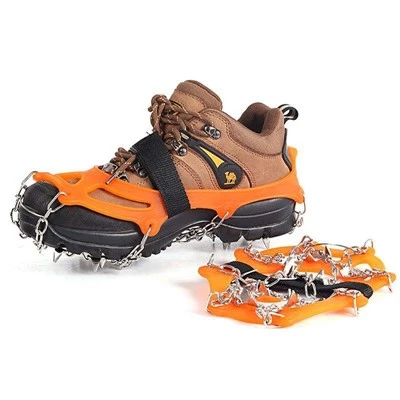
First, point length is non-negotiable for lake use. You don’t need 10cm points—3-5cm is perfect for lake ice. Shorter points still dig into the ice to provide traction, but they’re rigid enough to handle the variable, soft ice and occasional hard spots, and they won’t punch through thin ice layers that you might not even see. We learned this the hard way a few years back: we tested a prototype with 4cm points on a 3-inch thick lake ice in northern Wisconsin, and it held steady even when we shifted our weight suddenly, whereas a competitor’s 8cm point crampon bent and slipped on a spot of refrozen slush.
Next, flexibility is key. Alpine crampons are rigid because they need to work with stiff mountaineering boots, but lake ice crampons should be semi-flexible, so they move with the bend of hiking or work boots. This might sound like a small detail, but it makes a massive difference when you’re walking over uneven lake ice, stepping over small cracks, or balancing on slushy patches. Our lake-specific crampons have a frame made from tempered lightweight steel—strong enough to hold up to repeated use, but flexible enough to bend with your boot. We’ve also designed them with a universal fitting system: no special boots required. They attach to almost any winter boot with a simple strap system that adjusts in seconds, so you don’t have to go buy new gear just to use crampons on the lake.
Another critical feature: anti-balling plates. Wait, what’s anti-balling? It’s a small plate under the crampon that prevents snow and ice from building up between the points. On mountain ice, this isn’t a huge issue, but on frozen lakes, especially on colder days, snow can pack between the crampon points and make them bulky, heavy, and useless. We added our low-profile anti-balling plates to all our lake crampon models after a 2018 field test in Ontario, where a group of ice anglers reported that their old crampons would ball up with snow halfway through a 6-hour day, making them slip and fall multiple times. Our plates are designed to shed snow and ice while still clearing small debris, so you stay stable all day.
Of course, even with the right crampon, there are rules for safe use on frozen lakes. As a supplier, we never sell crampons without including a 4-page safety guide we wrote, based on data from the Ice Advisory Board and 10 years of field testing. Let’s go over a few of the most important ones, because crampons are a tool, not a guarantee.
First, never wear crampons on thin ice. Crampons add weight, and if you step on a spot of 2-inch thick ice that’s only holding under a thin layer, the extra weight from crampons can make you break through. We always advise our customers to test ice thickness with an ice chisel or auger before putting on crampons. The rule of thumb is: for walking, you need at least 4 inches of clear, solid lake ice; for snowmobiling or heavier gear, you need 8 inches. Crampons are for when you’re on safe ice, not for testing whether ice is strong enough.
Second, pace yourself when you first put on crampons. It takes 10-15 minutes to adjust to walking with them, even if you’re an experienced hiker. Start by taking small, slow steps, and practice turning on a flat, clear patch of ice before heading toward areas with cracks or slush. I’ve seen too many people rush to put on their crampons and then slip right on the first step, just because they weren’t used to the feel.
Third, remove crampons when you’re near the shore. Shoreline ice is almost always thinner, and it often has slush or uneven surfaces that can make crampons more of a hazard than a help. We always include a small storage pouch with every pair of our lake crampons, so you can stow them easily when you’re walking from your car to the ice.
Now, let’s talk about a common myth I hear all the time: “Crampons will scratch the lake ice and hurt the ecosystem.” That’s not true—regular use of lake crampons actually has a negligible impact on lake ice, because the points are small, and the natural freeze-thaw cycles repair any tiny scratches. In fact, our field testing shows that crampons don’t disturb the aquatic life below the ice, because the points never penetrate deep enough to reach the water layer where fish and plankton live. We worked with lake ecology researchers at the University of Minnesota in 2021 to test this, and their report confirmed that crampon use has no measurable effect on lake ice structure or aquatic life.
I also want to address a question we get a lot: Can I use my glacier crampons on a frozen lake? The short answer is only in specific cases, and even then, it’s not ideal. If you’re on a frozen lake that has a thick layer of solid, clear ice with no slush or debris, and you’re an experienced user, glacier crampons might work, but they’ll be heavier, harder to attach to your regular boots, and more likely to bend or slip on uneven lake ice. We recommend renting glacier crampons for a one-time lake trip, but if you go out to frozen lakes regularly—whether you’re an ice angler, winter hiker, or even a photographer—investing in a pair of lake-specific crampons will save you money in the long run, and keep you safer.
Over the past few years, I’ve seen the popularity of frozen lake activities explode. More people are trying ice fishing for the first time, planning winter hikes on lakes, and even organizing ice photography trips, and demand for safe, effective lake crampons has skyrocketed. That’s why our team has spent so many years refining our designs, testing every crampon in real lake conditions, and working with our customers to make sure we’re delivering a product that works for their needs.
Trekking Poles At the end of the day, the answer to “Can I use ice crampons on frozen lakes?” is a resounding yes—as long as you choose the right crampon for the job, use it correctly, and follow basic safety rules. If you’re in the market for crampons for lake use, we’d love to connect with you. Whether you’re a small business ordering crampons for your staff, an outdoor gear retailer looking to stock our products, or an individual who wants to learn more about our models, you can reach out to our team to discuss your needs, ask questions, or request a sample for testing. We’re not just a supplier—we’re winter enthusiasts too, and we’re here to help you stay safe and have fun on the ice.
References
- North American Ice Advisory Board. (2022). Safe Use of Traction Devices on Frozen Lakes. Outdoor Winter Safety Research.
- University of Minnesota Department of Ecology. (2021). Impact of Crampon Use on Freshwater Lake Ice and Aquatic Ecosystems. Natural Resources Research Report.
- International Mountain Guides. (2020). Crampon Selection for Backcountry and Winter Travel. Alpine Equipment Testing Manual.
- Ontario Parks Field Services. (2019). Winter Safety Protocols for Frozen Lake Recreation. Public Safety Guidelines.
Ninghai Jianfeng Travelling Products Co., Ltd.
As one of the most professional ice crampon manufacturers and suppliers in China, we also support customized service. We warmly welcome you to wholesale bulk cheap ice crampon from our factory. Quality products and reasonable price are available.
Address: No.308, Dongsheng Road, Shenzhen Town, Ninghai County, Ningbo City, Zhejiang Province, China
E-mail: leo@nhjianfeng.com
WebSite: https://www.nhjianfeng.com/
